Menu


Share
ARE YOUR FOALS REALLY PROFITABLE?
Key takeaways
- Use a fully loaded model: assess each foal’s sale price against all directly attributable costs—not just the stallion service fee.
- Include the mare’s economic cost: allocate mare holding costs and a reasonable amortisation expense across expected lifetime foals.
- Value breeding rights and stallion shares appropriately: use the market nomination value for a breeding right or amortise a stallion share over its expected nomination life.
- Keep overheads separate: general operating expenses may be assessed below the line so the core calculation reflects the economics of the individual mating and foal.
- Treat the “three times service fee” rule as a guide only: it ignores many material costs and is not a reliable substitute for a detailed profitability calculation.
- Maintain strong records: tracking foal profitability supports better breeding and capital-allocation decisions and may help demonstrate that the operation is conducted as a business for income tax purposes.
In the many years I have spent consulting to the thoroughbred industry, with a particular focus on tax and financial outcomes, I have yet to encounter an authoritative model that enables breeders to accurately determine whether their foals are genuinely generating a profit.
The cost of mares, service fees and maintenance of both mares and foals is very significant for commercial breeders, thus having some sort of “rule of thumb” is highly recommended in determining if your breeding operations are viable.
This article reflects the deep dive I have done on this issue and is intended to be an easy reference for breeders to establish their profitability. The key to business success is tracking your progress in a meaningful way, so I can only hope many of you find it as enlightening as it is constructive.
It is well worth noting that the keeping of proper records is a significant factor in the ATO determining if a breeding operation is being conducted for income tax purposes, so keeping ancillary records on foal profitability is a powerful indicator in meeting this requirement.
1. The “core” formula
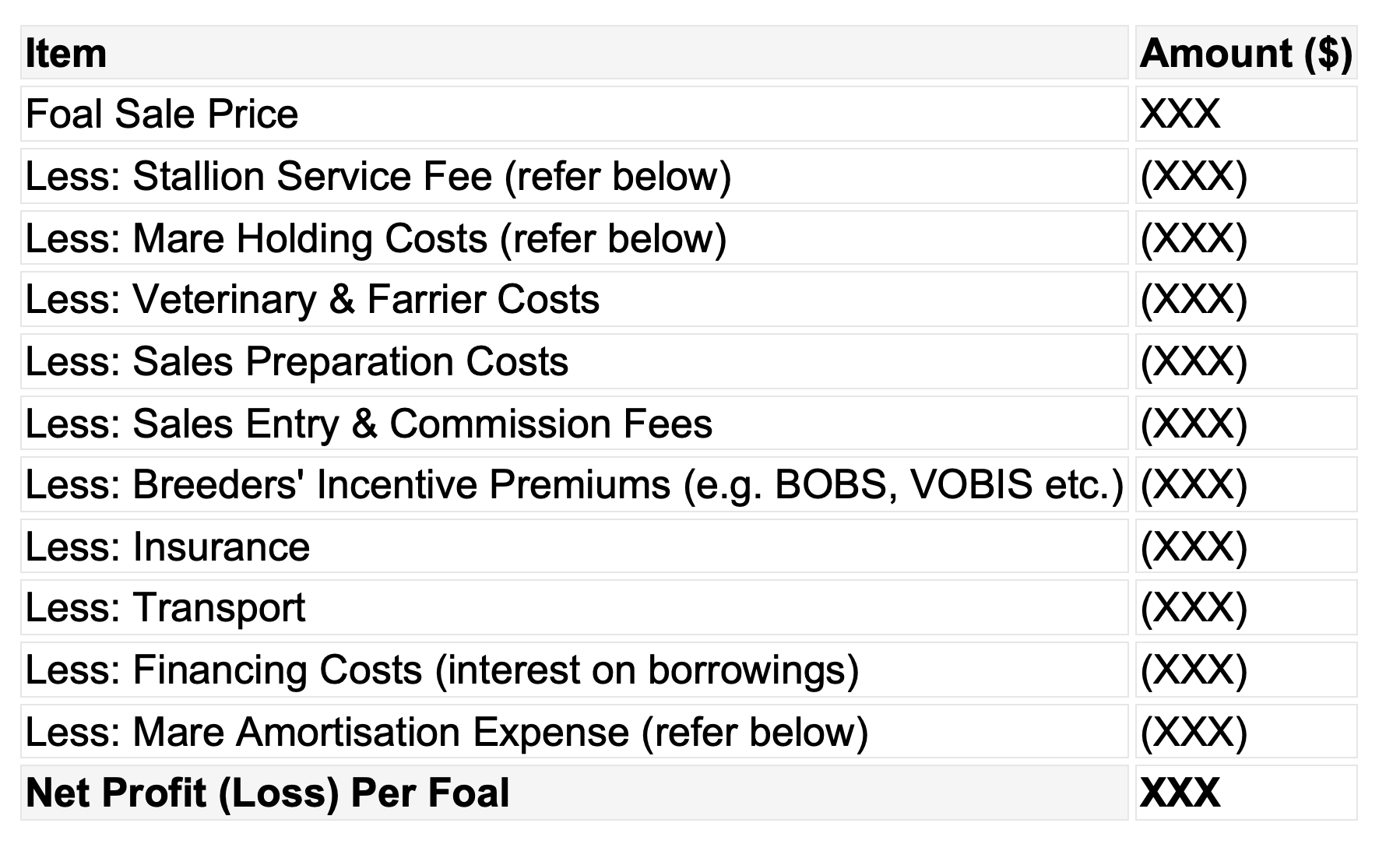
If you're a thoroughbred breeder, the best way to determine whether you truly made a profit on a foal sale is to use a “fully loaded” economic profit model, not just compare the sale price to stud fee and direct costs.
The Core Formula
The profit or loss is equal to:
Comments
a) “Mare holding costs”
I would define mare holding costs as the costs of maintaining the mares that are directly attributable to producing that particular foal. Typically, this would cover her costs from conception (or service date) through to weaning of the foal.
b) “Mare amortisation expense”
The most contentious item is the “mare amortisation” expense. There is an argument that you could instead use a “depreciation” or “opportunity cost of a mare”.
The reference to "depreciation" is not intended to invoke the tax write-off rules applicable to broodmares. Rather, it refers to an accounting or valuation-based depreciation rate that may have been prescribed by the ATO or accounting standards. Interestingly, no such prescribed depreciation rate exists for broodmares, unlike certain other classes of assets, such as racehorses in training.
The “opportunity cost of a mare” relates to the return you could have earned on employing her capital cost elsewhere.
Example 1
A broodmare cost is $500,000. Required return 8%. Mare capital $500,000. Opportunity cost of mare capital $40,000 per year.
My personal preference is to use a mare amortisation expense. Many of my breeding clients/contacts prefer this approach too.
With this approach, you treat the broodmare as a productive asset and allocate her acquisition cost across the foals she is expected to produce.
Example 2
Purchase price $600,000, expected lifetime foals 8. Recoverable cost is $600,000. This assumes the mare has NIL residual value as she is being kept for her entire breeding career. To insert in the core formula, the cost allocated per foal is $75,000 ($600,000/8 lifetime foals).
There isn't a single globally accepted number, but in commercial thoroughbred breeding financial models a broodmare is often assumed to produce approximately 6 to 8 lifetime live foals, with 7 commonly used as a base case. I’ve used 8 in my example assuming the mare was acquired straight off the track or at a very young breeding age. If the mare is acquired later in her breeding life, you would adjust that figure downwards accordingly.
c) Stallion service fees
This is obviously the cost of stallion service fee; however, complications arise if a breeding right or stallion share is utilised to breed the foal.
Breeding Right
Acquiring a breeding right typically means purchasing the right to breed one mare per year to a particular stallion, usually for as long as the stallion stands at stud (subject to the specific terms of the syndicate agreement). These have become very common in the past 20 years here and globally.
So, do you allocate part of the purchase cost of the breeding right, say based on the stallion’s actual expected life at stud, or some other basis?
My preferred method is a “market nomination value”, which is simply current public service fee, say $50,000 (excl GST)
Even though you don't write a cheque for $50,000, you've consumed something worth $50,000.
Stallion share
A stallion share is an ownership interest in a stallion syndicate. When a breeder acquires a stallion share, they're not just buying access to a service; they're acquiring an ownership interest in the stallion and certain contractual rights associated with that ownership.
For the purposes of the core formula above, I would insert a figure that amortises the share cost over the “Expected Nomination Life” of the stallion, for example:
- Stallion Share Cost $1,000,000
- Expected Stud Life 20 years
- Annual Nomination Right – 1 (if more nomination rights especially in the early years, the formula for expected stud life is adjusted upwards to take account of more services being available). Thus, 20 years could be 23 years if the breeder can use 2 rights in the first three years and one p.a. thereafter.
- Cost to allocate would be $1,000,000/20 years stud life = $50,000
Example 3 – foal profitability using the core formula
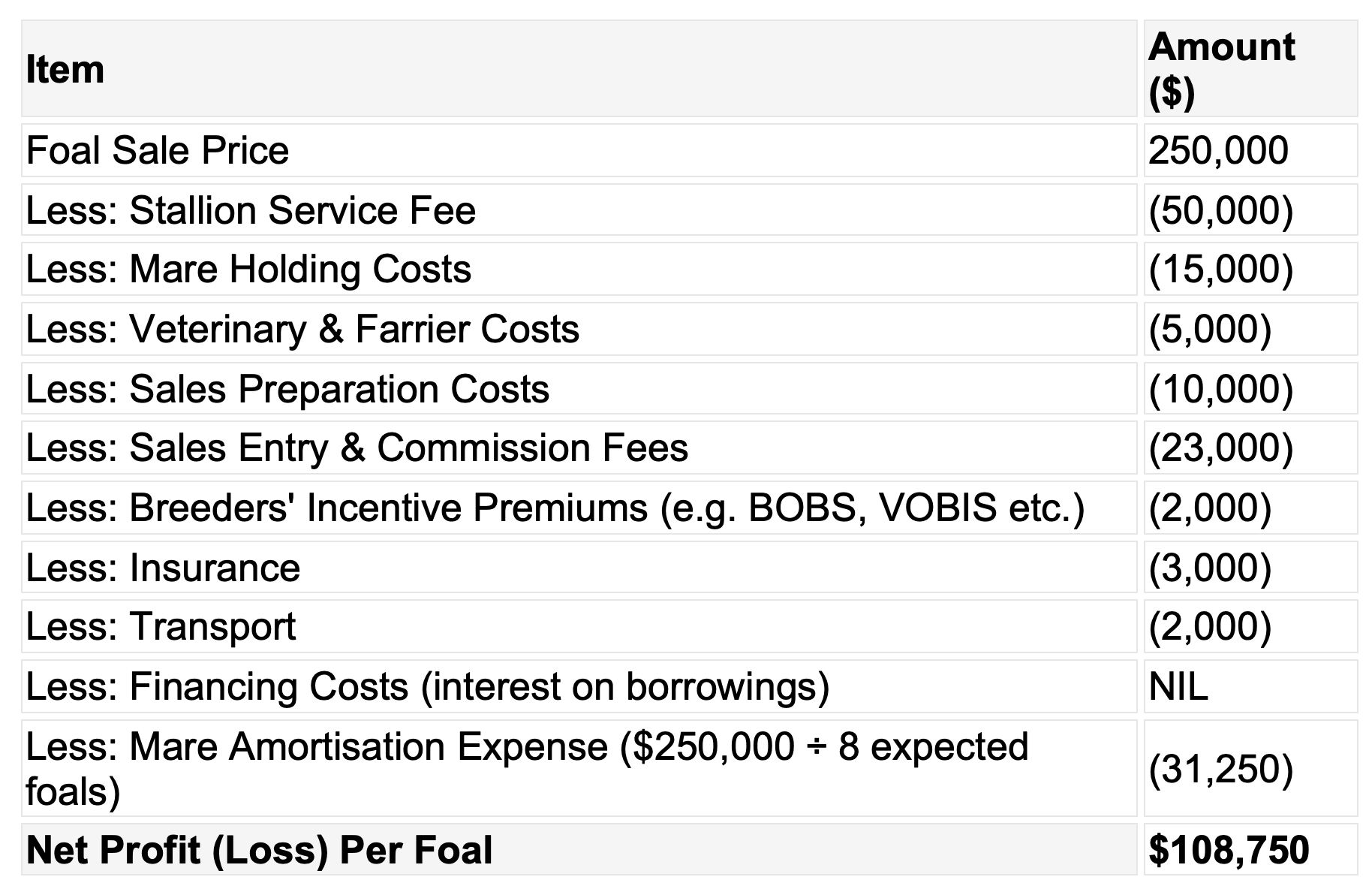
Assume a foal is sold for $250,000. Applying the core formula, the breeder would calculate the net profit per foal by deducting the relevant fully loaded costs, including the stallion service fee, mare holding costs, veterinary and farrier costs, sales preparation costs, sales entry and commission fees, breeders’ incentive scheme costs, insurance, transport, financing costs and mare amortisation expense.
In this example, mare amortisation is calculated as $31,250, being $250,000 divided by 8 expected foals, on the basis that a new young mare is acquired at the start of her breeding life.
2. Operating expenses – should you include?
The core formula above does not include general breeder operating expenses, e.g. property rates, accounting, vehicle expenses, travel etc. In Accounting speak, we call these “below the line” expenses.
This is actually one of the most important debates in breeding economics.
The argument for excluding general breeder operating expenses from the core foal profitability formula is that those costs are often fixed overheads, whereas the objective is to determine whether a particular mating or foal created value. These fixed overheads are often peculiar to the vendor as they vary with property size, quality of travel and vehicles, extent of accounting services and bookkeeping etc. Hence, their inclusion can produce unreliable results and doesn’t reflect the success of your core activity of breeding profitable foals!
3. Industry Rule of Thumb of “3 times service fee” – is it relevant?
A commonly cited benchmark in the thoroughbred industry is that a foal should sell for approximately three times the stallion service fee in order for the breeder to make an acceptable profit.
While this can be a useful preliminary indicator, it should not be relied upon as a measure of actual profitability. The rule takes no account of mare holding costs, veterinary expenses, sales costs, transport, financing costs, insurance or the economic cost of the broodmare investment. Consequently, a foal may achieve the "3 times service fee" benchmark yet still generate a loss when assessed using a fully loaded profitability model.
Conversely, some breeders may generate a profit at less than three times the service fee where mare acquisition costs are low, operating efficiencies are high, or a nomination has been obtained at below-market cost. Accordingly, the "3 x service fee" benchmark is best regarded as a broad industry guide rather than a substitute for a detailed profitability calculation.
Breeders who consistently measure profitability using a fully loaded model, as noted above, are better positioned to make informed breeding decisions and allocate capital effectively
If you wish for me to clarify or expand upon anything mentioned in this article, please do not hesitate to contact me.
Any reader intending to apply the information in this article to practical circumstances should independently verify their interpretation and the information’s applicability to their circumstances with an accountant or adviser specialising in this area.
Contributions from
No items found.
Thank you! Your submission has been received!
Oops! Something went wrong while submitting the form.
Related
No items found.