Menu
Back to Insights
Insights
23 April 2026
Long-term investor? Avoid trying to time the market

Key Insights:
1. Market timing rarely works - missing just a handful of strong recovery days can significantly erode long-term returns.
2. Successful investing isn’t about perfect timing -it’s about staying invested through volatility and letting compounding do the work.
3. Investors who react to fear and exit the market often miss the rebound, locking in losses and underperforming over time.

Share
Trying to time the market is appealing, intuitive - and deeply human
However, as a long term wealth building strategy, it relies on consistent accurate predictions and a level of precision that very few investors can achieve.
History suggests that patience, discipline and time in the market, not perfectly timed decisions, are the most reliable drivers of long term investment success.
When markets are volatile, the most productive decision is often not doing something, but sticking to a strategy designed to weather exactly these kinds of periods.
Why Trying to Time the Market Rarely Pays Off
When markets are volatile, it’s tempting to believe the smartest move is to sell before prices fall and buy back once things feel safer.
The problem is that market timing is far harder than it sounds.
Market highs and lows are only clear in hindsight. At the time, investors are reacting to headlines, forecasts, and emotions - not certainty. Even professionals rarely get timing right consistently.
Importantly, timing the market means being right twice: knowing when to get out and when to get back in. Many investors miss the return rally because it often begins when confidence is still low.
History also shows that long term returns are driven by a small number of strong market days, which tend to occur during turbulent periods. Investors who step aside risk missing those days and the damage to long term outcomes can be significant.
Apart from the high probability of missing turning points investors who move in and out of the markets face higher transaction costs (e.g. brokerage) and may trigger unintended tax consequences (e.g. capital gains tax).
A Simple Illustration
The chart below compares three historical investor experiences starting just before the global financial crisis in October 2007 through to October 2013 with an initial $10,000 investment.
1. Green line - the investor remained fully invested through the market cycle.
2. Orange line - the investor exited the market at the bottom, held cash 12 months then re-invested in the market.
3. Red (dotted line), the investor exited the market at the bottom remained in cash.
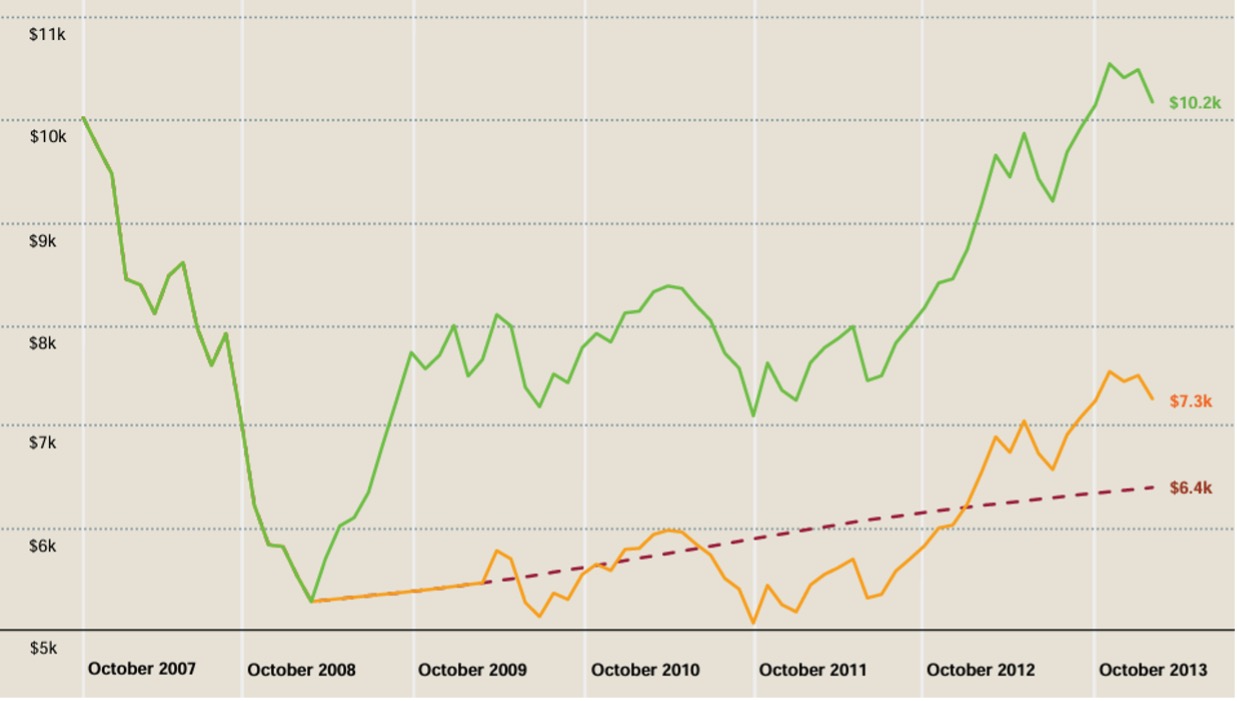
While it may have been uncomfortable, the investor who stayed invested (green line) clearly had a better investment outcome than the investors who moved to cash (and reinvested later – orange line) or remained in cash – red dotted line.
Key Principles
1. Markets don’t signal when they’ve hit a bottom and recoveries frequently begin when investor confidence is still low.
2. Missing just a small number of strong days can materially reduce long term returns.
3. Successful long-term investing involves staying invested through market cycles.
If you’d like to discuss any of the issues raised in this article, please contact Brad Hunt at our office.
Disclaimer
The information provided in this article is general in nature. It has been prepared without taking into account your objectives, financial situation or needs. Before acting on any information in this presentation you should consider whether it is appropriate, having regard to your own objectives, financial situation and needs.
The illustrations and charts shown are hypothetical and for educational purposes only. They do not represent actual or future performance of any investment or market, including the Australian share market. Past performance is not a reliable indicator of future performance.
Investment returns are not guaranteed, and all investments carry risk, including the risk of loss of capital.
Baumgartner Financial Services Pty Ltd is Corporate Authorised Representative No. 1249364 of Advice Assist Australia Pty Ltd (AFSL 496692).
Contributions from
No items found.
Thank you! Your submission has been received!
Oops! Something went wrong while submitting the form.
Related
No items found.